Brussels’ transparency lobby faces the transparency test
TI-EU branded Parliament’s NGO oversight group "illegitimate". EU Money Monitor traced €7.29bn: invisible workforce, partial audits, removed OLAF tables and the unanswered question: who gets paid?

In Brussels, every hard question about EU money meets the same reflex: criticism feeds the far-right, so stay quiet and pretend the Union is perfect.
A company that receives EU money is a contractor; it discloses according to its legal form. An advocacy NGO that lives on EU money claims something more: to represent citizens and the public interest. That claim opens institutional doors and creates an authority no ordinary contractor claims.
The authority to speak for citizens and the refusal to show citizens the receipts cannot live in the same organisation.
The NGO disclosure rules were written for small associations that needed protection from excessive paperwork. The same legal forms now carry organisations managing tens of millions in EU grants, running dozens of parallel grants and declaring as little as one full-time employee.
The exclusion is explicit. The EU’s accounting directive created a harmonised framework for specified limited-liability companies and left non-profits outside its scope. Companies enter a common disclosure architecture by legal form; associations and foundations depend on a national patchwork that often does not scale with the public money entrusted to them.
⚠️ For NGOs, the result is protection from public view.
If non-profits can receive lighter public-disclosure duties than companies while exercising public-interest authority and receiving large EU grants, asking for stronger visibility is not “an attack on civil society”; it is equal treatment of public money.
The politics excuses no one. The right built an NGO scrutiny working group and turned it into a political weapon. The Socialists, Renew, the Greens and the Left walked out and called it a “witch hunt”.
Neither side counted the money. Neither side brought in more than opinions and political beliefs.
The €7.29 billion traced by this investigation, contracted to Belgian NGOs and non-profits, has no political party. Neither do the taxpayers who funded it. Neither should EU anti-fraud oversight.
“Witch hunt” is what powerful people call accountability: the revolving door turns both ways
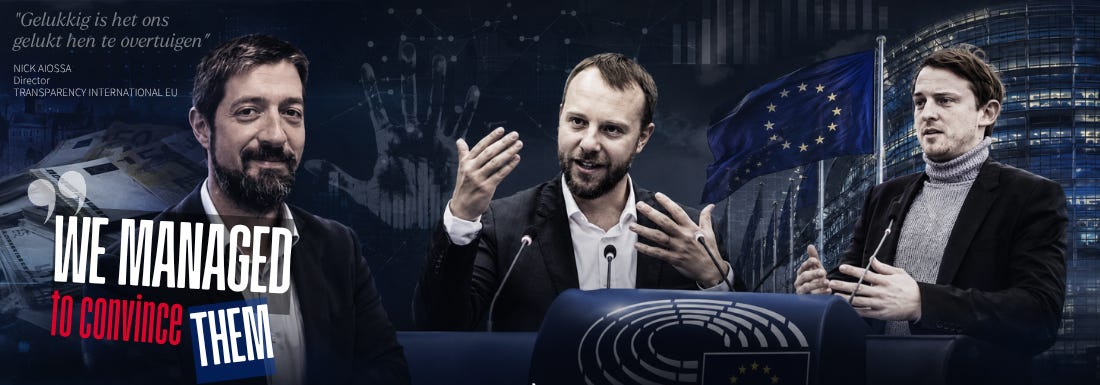
“We managed to convince them”.
Nick Aiossa, director of Transparency International EU (TI-EU), was describing a lobbying success. “Them” meant four political groups in the European Parliament: the Socialists and Democrats, Renew Europe, the Greens/EFA and the Left.
What TI-EU had convinced them to do was boycott Parliament’s Scrutiny Working Group on NGOs, the body created to examine Commission grant agreements with NGOs and other entities.
Aiossa called the group “a political, theatrical witch hunt”. In his written response to EU Money Monitor, he confirmed that TI-EU had “successfully advocated for some political groups to boycott the illegitimate Scrutiny Working Group on NGOs”.
An organisation founded to defend integrity in the EU institutions had declared illegitimate a parliamentary accountability mechanism formally established within those institutions to examine public money.
The organisation said that advocacy was funded exclusively by private foundations. This investigation does not allege that European Commission grants financed the boycott campaign.
The boycott came first. Parliament’s budget verdict came later.
In April 2025, a letter signed by Civil Society Europe, Transparency International EU and the European Environmental Bureau told Parliament there was “no evidence of corruption, wrongdoing or maladministration”. The Belgian Official Gazette records TI-EU director Nicholas Anthony Aiossa not only representing TI-EU, but also among Civil Society Europe’s administrators since 21 June 2023. The later boycott letter argued again that the working group had established no misuse of EU funds, breach of rules or maladministration.
Parliament’s final resolution on the Commission’s management of the 2024 EU budget then echoed the same NGO defence architecture, aligned around the same claims carried by the April three-signatories letter.
The rapporteur for Parliament’s resolution was Daniel Freund.
Before entering Parliament, Freund spent almost five years at Transparency International EU as Head of Advocacy for EU Integrity and worked on EU Integrity Watch, TI-EU’s platform for making lobbying meetings and financial interests visible.
Open that platform today. In the 10th-legislature results displayed by Integrity Watch, Transparency International EU is first among organisations in Freund’s declared meeting results.
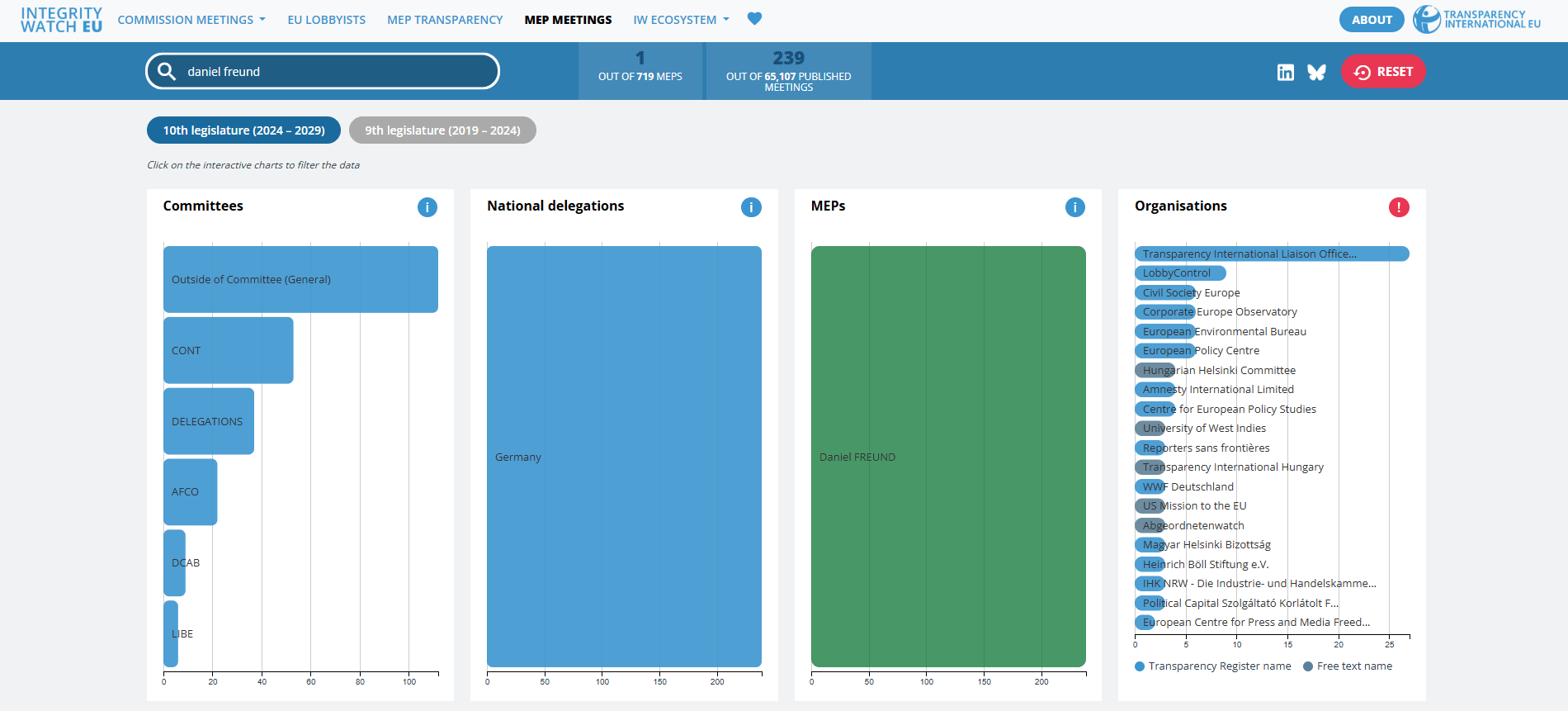
The watchdog’s own tool now places the watchdog at the top of its former employee’s meeting record.
The dates are declared and public. The official 2024 discharge procedure file records Freund meeting the Transparency International EU on 5 November 2025, after he had become rapporteur. Parliament’s separate MEP meeting register records TI-EU meeting Freund and, separately, Erik Marquardt on 17 November under “CONT Scrutiny Working Group”, the date carried by the boycott letter. On 6 May 2026, the register records TI-EU among the organisations meeting Freund under “Attack against civil society”, the day Aiossa’s “we managed to convince them” interview was published.
These are declared meetings on public registers. They establish timing and subject.
Lobbying Parliament is lawful. Freund declared the meetings. The resolution for which he served as rapporteur also demanded robust, proportionate and risk-based scrutiny of every recipient of EU money and warned that selective transparency undermines trust in the discharge process.
But the institutional proximity is part of the public record. The revolving door did not have to be hidden. It was registered.
And the sentence Parliament adopted still requires examination.
The Commission’s review “found no breaches of the law”. That records the result of the review performed. It does not tell citizens how many agreements were examined, which programmes or years were covered, what tests were applied or what limits the review had.
⚠️ It is not a documented clean bill of health for the entire NGO funding system.
The political fight produced a verdict. It did not produce a public map of the money: who received it, what legal entity stood behind the name, what workforce appeared in national records, what accounts were published, and how many EU grants were running at the same time.
EU Money Monitor built one.
Belgium: where €7.29 billion meets the public record
Between 2014 and 2024, the European Commission’s Financial Transparency System recorded €7.89 billion in grant commitments to Belgian-registered NGOs and non-profits. Belgium ranks second in the EU, behind Germany and ahead of France, Spain and the Netherlands.
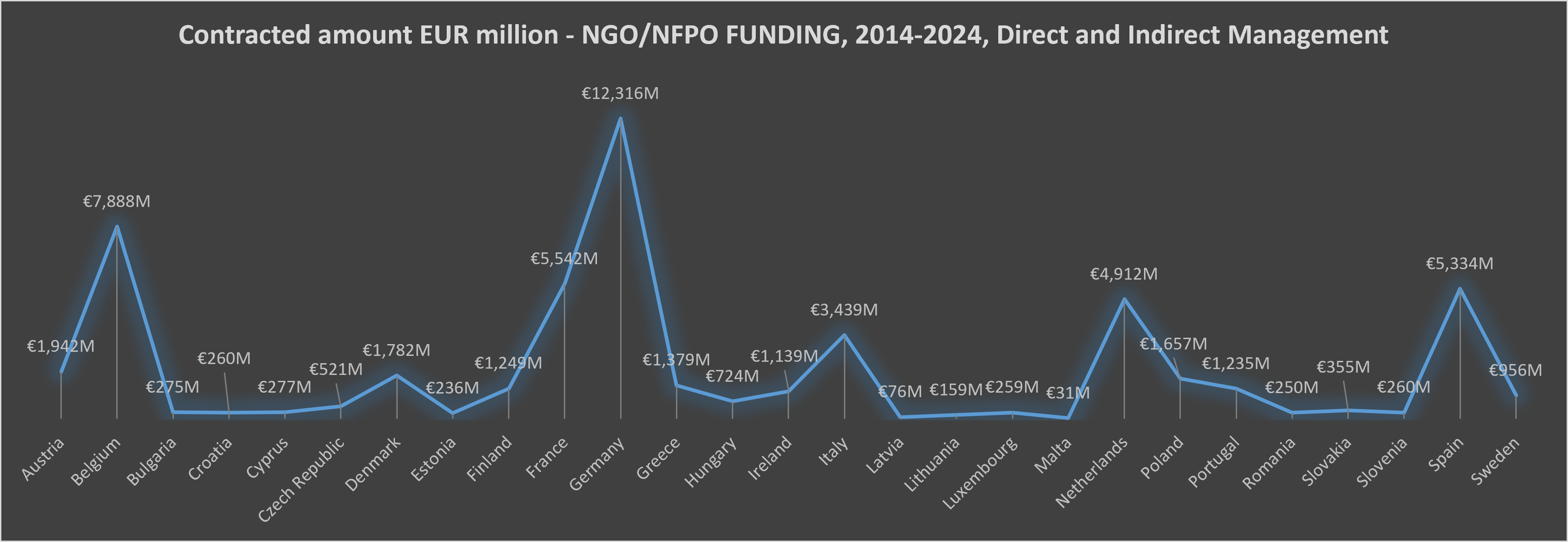
That concentration is not accidental. Brussels hosts the European institutions and the advocacy platforms, international networks and European-level associations built around them. This is not merely a Belgian funding system; it is a large part of the EU civil-society funding system operating through Belgian legal entities.
The Commission published the money through 22,179 grant rows under 2,507 beneficiary name strings.
EU Money Monitor connected those records to three Belgian public registries: the Crossroads Bank for Enterprises for legal identity, the National Social Security Office for employer registration, and the National Bank of Belgium for financial filings.
The result is the Belgian NGO Funding Intelligence Pack: 758 verified legal NGOs/NFPOs receiving at least €500,000 in total over the period, together representing €7.289 billion, or 92.41% of the full Belgian total.
The first test was the most basic: who received the money?
Of the 2,507 beneficiary name strings published by the Commission, 990 carried no Belgian VAT number or identifier in any grant record. Separately, 1,103 combined multiple names or spelling variations in a single entry. Before the sector could be examined, the beneficiaries first had to be identified.
The second test was equally basic: what workforce is visible behind the grants?
Some 126 NGOs, collectively contracted for €680 million, were not registered as employers with the Belgian social-security authority. A further 172 declared between one and four employees. Together, 298 NGOs with no more than four workers visible in Belgium’s public employer register managed €1.20 billion in EU grants.
That does not mean those organisations had no workforce. They may operate through consultants, foreign employees, secondees, partners, volunteers or related entities. It means those delivery structures cannot be reconstructed from the Belgian employer register alone.
The third test was the public financial record.
For 285 NGOs managing €1.74 billion, no annual account was traceable through the National Bank’s standard public register. Another 301 NGOs, managing €1.87 billion, filed only simplified or micro accounts. Only 123 of the 758 filed complete accounts.
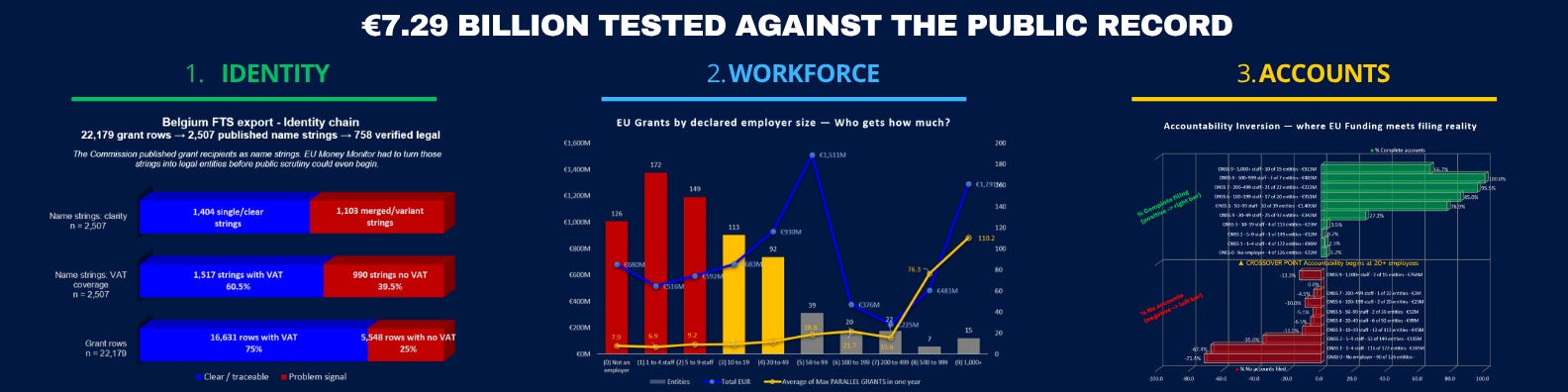
These figures do not establish fraud, misconduct or illegality. They establish that the three most basic public questions: who received the money, what workforce appears behind it, and what financial record citizens can consult, cannot be answered consistently from the systems that already exist.
NGO scrutiny begins with missing public information, not with political suspicion.
Belgium is the pilot. The method is designed to be repeated. The organisations’ own replies now show what sits behind the registry gaps: employment abroad, consultants, service contracts, related entities, cascade funding, partners and network delivery.
The registries reveal the gap, the organisations explain it.
The money is public. The workforce is not.
Five organisations were selected for detailed profiling from the 758 verified Belgian entities. The criteria were applied uniformly: high EU grant volume contracted in the organisation’s name and EU grants running in parallel (Source: EU Financial Transparency System), low visible employer or payroll footprint against that volume, and expenditure concentrated under services lines.


Each organisation received the figures drawn from its own public filings, each was asked to identify any factual error. Each was also asked the basic public-interest question: who performed the publicly funded work, under what contractual structure, and where can citizens verify it?
The full right-of-reply correspondence and replies are published with this article on money-monitor.eu.
The public registries show one picture. The replies show another.
The registry picture is simple: EU grant amount, legal entity, employer footprint, payroll, services expenditure, filing format.
The organisational picture is wider, and much harder to verify from outside: foreign employees, consultants, field experts, in-house service contracts, cascade funding, public procurement, partner delivery, donor reports, internal controls and audits.
Both pictures can be true. Only one is public.
ECAS - European Citizen Action Service is the control case for this selection. It received €27.94 million in EU grant commitments, and its public accounts show personnel costs, workforce figures and social-balance information. ECAS confirmed that Belgian employees are registered in Belgium and Bulgarian employees with the Bulgarian authorities. It also stated that its accounts are independently prepared, audited, reviewed by the board and approved by members. Where an organisation files visible workforce data, citizens can see a real employment structure.
Even there, the limit appears. ECAS confirmed: “The accounts’ format does not allow a breakdown by type of expenses indeed.” The public can see payroll. It cannot see, inside the combined goods-and-services line, the detailed split between consultants, project services, administration and other operating costs - 64% of what is visible in the Belgian records.
OASC - Open & Agile Smart Cities shows the next layer. The FTS records €21.87 million in its name across 37 actions. It has not been registered as an employer in Belgium since November 2021. Its 2024 accounts show zero declared payroll and zero staff FTE. Its website lists the people doing the work.
OASC explained why. In 2022, its governing body moved from employment contracts to service agreements with in-house consultants. It also corrected the grant picture: 16 projects were actively delivered in 2024, not 30, and €15.84 million of the FTS total was cascading funding passed to third parties, not money retained for OASC’s own operations.
Those corrections are reflected. They do not remove the public-record problem. OASC wrote that it takes “extensive searching” to piece together the information from public sources, “even for me” while preparing the reply, and that project websites “cannot be considered official public records”.
The explanation exists in the reply. The workforce does not become visible in the public registry.
Interpeace Europe presents the same divide. The FTS records €15.86 million in Interpeace Europe AISBL’s name. Its Belgian employer footprint is in the 1–4 band. In the years where services are separately visible, most combined workforce-related expenditure appears under services rather than payroll. In 2024, its accounts recorded €212,107 in payroll against an average workforce of zero.
Interpeace replied that “it is important to distinguish between public statutory accounts and grant-level reporting.” Correct. Grant-level reporting may contain details that statutory accounts do not. But grant-level reporting is not the public record citizens can consult.
The unanswered question remains where that delivery structure can be verified publicly: Interpeace Europe itself, headquarters, country offices, related entities, partners or external personnel.
PSCE - Public Safety Communication Europe shows a fourth version of the same problem. The FTS records €17.31 million in its name. It is not registered as an employer in Belgium. It lists no staff publicly, its public accounts leave workforce-cost fields blank.
PSCE replied that, as coordinator, it distributes funding among public and private organisations, and that in some projects “a very large portion of the grant (up to 70%) is allocated to public procurement”. That may explain why large amounts appear under PSCE’s name.
ECES - European Centre for Electoral Support is the largest and most revealing case. The FTS records €77.98 million in ECES’s name across 34 actions. ECES states publicly that around 83% of its funding comes from the European Union. Its Belgian employer footprint is in the 1–4 band. Across eleven filed annual accounts, ECES recorded €102.9 million under services and miscellaneous goods, against €1.57 million in declared payroll.
That public line matters. It is the same accounting category that can contain rent, printing, IT, professional services, field experts, consultants and management services. From that line alone, citizens cannot know who was paid to deliver the work, under what contract, or at what aggregate cost.
ECES answered extensively. It described itself as “a field-oriented implementation organisation rather than a headquarters-oriented organisation”. It said its work is implemented mainly outside Belgium and outside the EU, through project-based experts, consultants, collaborators and service providers. It referred to ISO 9001, TRACE certification, internal controls, donor audits, expenditure verifications and European Court of Auditors controls, and stated that those controls identified no fraud, significant ineligible expenditure or systemic weakness.
This article disputes none of that.
It asks what remains visible to the citizen who does not have access to ECES’s internal files, donor reports, audit folders or project documentation.
The strongest sentence in ECES’s reply is the operating model itself: “payroll data alone does not provide a complete or accurate picture of the human and technical resources mobilised”. Exactly. Payroll does not show the full workforce. But the public accounts do not show the full consultancy and service structure either.
ECES also stated that certain persons serving in governance or advisory roles may, where justified by operational needs, be engaged under “separate and distinct professional arrangements” to provide services to projects. ECES stated that such arrangements are subject to safeguards, donor rules, conflict-of-interest procedures, controls and auditability.
The public filings do not show the nature, value or recipients of those arrangements. That is the missing layer.
The question is not who receives a private salary. It is who is paid through the non-profit, from public money, once expenditure leaves payroll and enters services.
That is where the word “non-profit” stops answering the question. A non-profit may not distribute profit to shareholders. It can still route public money through service contracts, expert fees, management arrangements, procurement structures and related professional relationships. Some may be entirely proper. Some may be essential to delivery. But the public record often does not show enough for citizens to tell the difference.
The same visibility standard applies to institutional proximity. ECES contested the concept, calling it an analytical interpretation rather than a factual indicator. The public facts remain relevant. Fabio Bargiacchi founded and leads ECES after prior senior experience in EU electoral-assistance structures. Monica Frassoni, ECES president since 2013, previously served as a Member of the European Parliament and later as co-president of the European Green Party, while also holding governance roles across Brussels policy organisations. ECES’s answer is that such experience is professional qualification, not dependence.
This investigation makes no allegation of impropriety. It records a visibility standard: where EU institutional experience, governance authority, public funding and private contractual delivery meet, public traceability should be stronger, not weaker.
Across the five replies, the pattern is no longer theoretical.
The money appears in public systems. The workforce often appears somewhere else: in grant files, donor reports, project websites, consultant contracts, procurement arrangements, internal ledgers or audit folders.
That may be auditability. It is not public transparency.
The anti-scrutiny argument treats questions like these as suspicion. The right-of-reply record shows the opposite. The questions were basic, the answers were complex, the public record alone was not enough.
The next question is whether the oversight system closes that gap.
“We are audited” does not answer this record
The standard defence is simple: the Commission checks, auditors check, OLAF checks. The record does not support that comfort.
The Commission disclosed 45 HR-focused audits of Belgian private non-profit beneficiaries under Horizon 2020 between 2017 and 2024. Those audits tested €29.27 million in personnel costs and corrected €1.21 million. That is the documented check; and it is also the documented limit.
The disclosure covered Horizon 2020 personnel costs. The Commission stated that no Horizon Europe audit existed yet in the data released, and that no ex-post controls or desk checks could be identified. It did not provide a cross-programme, entity-level audit map of the Belgian NGO funding universe.
The European Court of Auditors draws an even clearer boundary. Its statement of assurance is based on sampled EU budget transactions. The Court told EU Money Monitor that it does not audit beneficiaries’ financial accounts, does not assess beneficiary-level control systems in its statement-of-assurance work, and does not categorise audited beneficiaries by entity type or Member State.
Its Special Report 11/2025 was not a regularity audit of NGO spending. The Court confirmed that it was not designed to verify the legality and regularity of EU funding spent by NGOs and did not include verification of personnel cost declarations.
Some transactions are sampled. Some supporting documents are examined. Some personnel costs are tested. Some corrections are made.
But the Court did not verify the workforce structures this investigation identified. It did not audit the accounts of the beneficiaries. It did not reconstruct whether entities managing many parallel grants had the staff, contractors or delivery structures visible in the public record.
Then comes the 0.7% figure OLAF did not publish.
OLAF had removed two country-level tables from its annual reporting.
After six months of access-to-documents requests, OLAF finally released one missing table: the incoming fraud suspicions per member State. This is what that table showed for 2019 to 2024, the period it was missing:
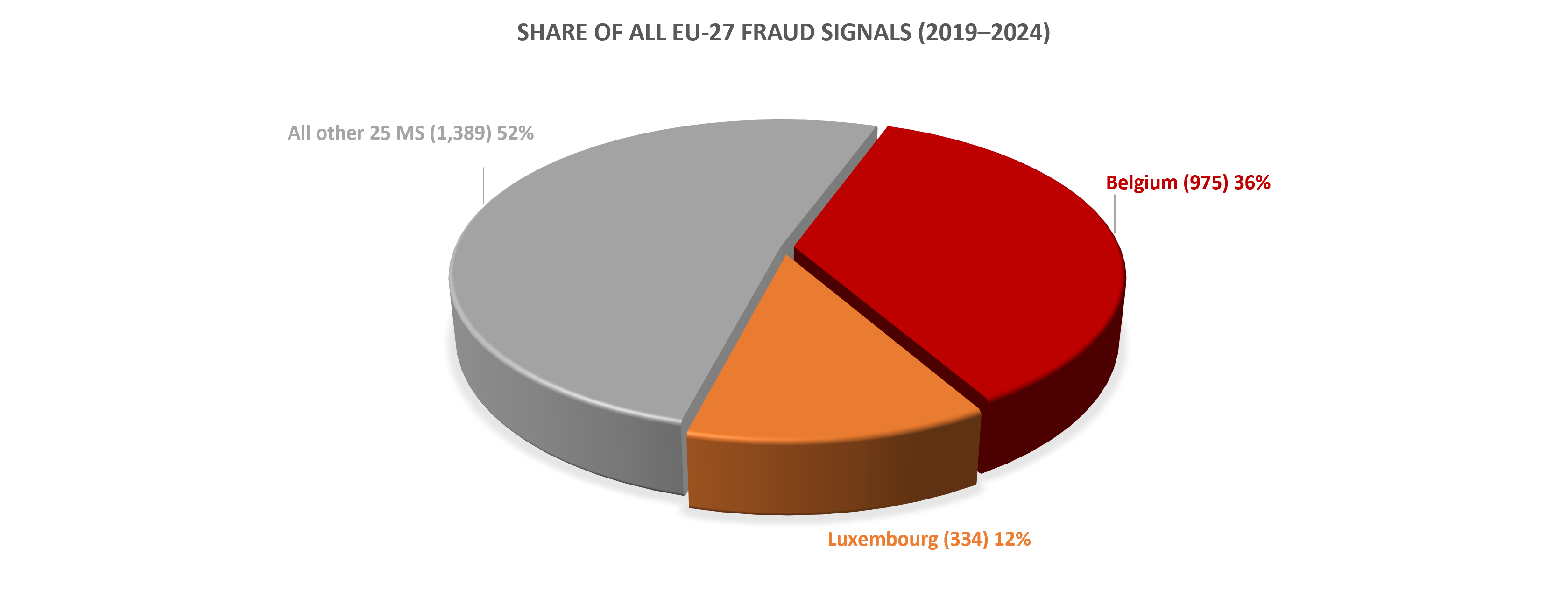
In its right-of-reply of 29 May 2026, OLAF’s spokesperson offered a different explanation for the removal than the one given in November 2025. The table had been “discontinued as an editorial choice, also in view of the significant risk of misinterpretation.” He added that the change had “improved clarity, which is a key element of transparency.”
Transparency is the virtue everyone upholds in speeches, until the numbers show something inconvenient. Then it becomes an editorial choice.
Here is the public output ratio: concluded investigations divided by incoming information deemed to be of investigative interest, using OLAF’s own annual reports and the table released under Regulation (EC) No 1049/2001.
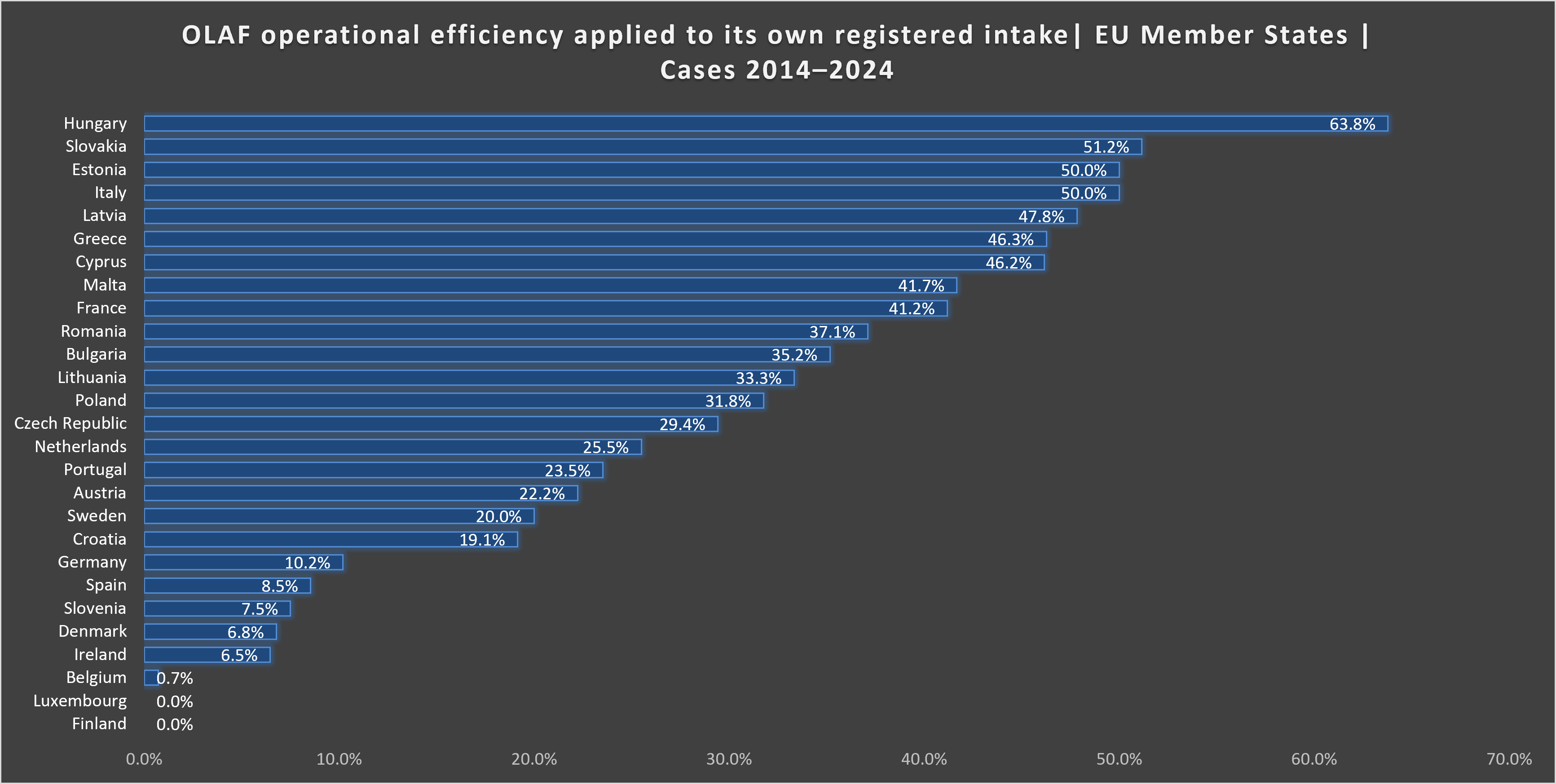
In 2025, OLAF removed a second table: the per-country breakdown of cases sent to EPPO. This table also showed Belgium first.
The contradiction, in OLAF’s own numbers.
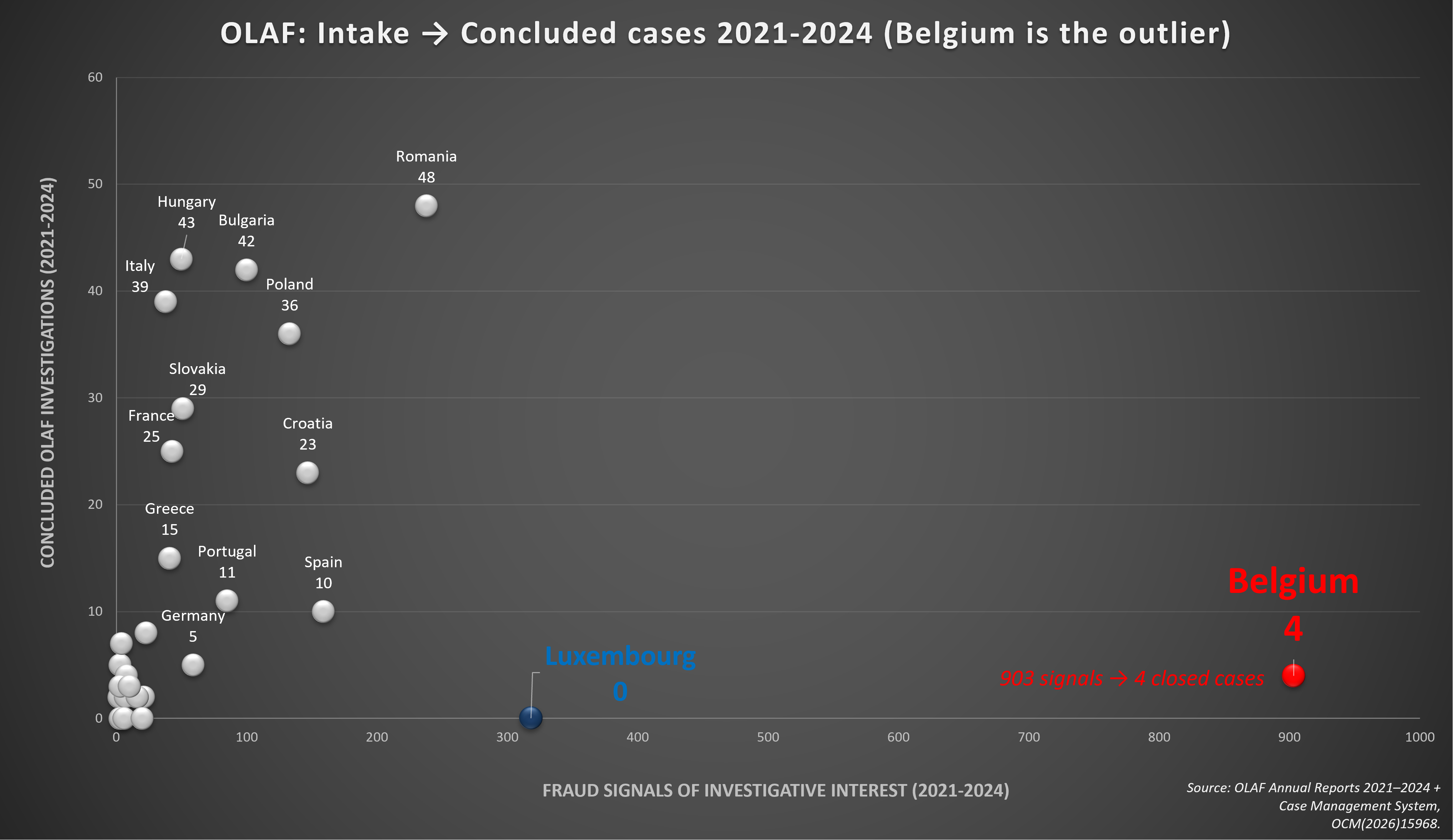
The first chart plots each member state’s incoming fraud signals for 2021–2024 against the OLAF investigations concluded in the same four years. Across the EU, other countries concluded real numbers of cases: Romania 48, Hungary 43, Bulgaria 42, Italy 39, Poland 36. Belgium sits alone at the far right of the chart, with more signals of investigative interest than any other member state, and produced four concluded cases. The largest intake in the Union, almost the smallest output.
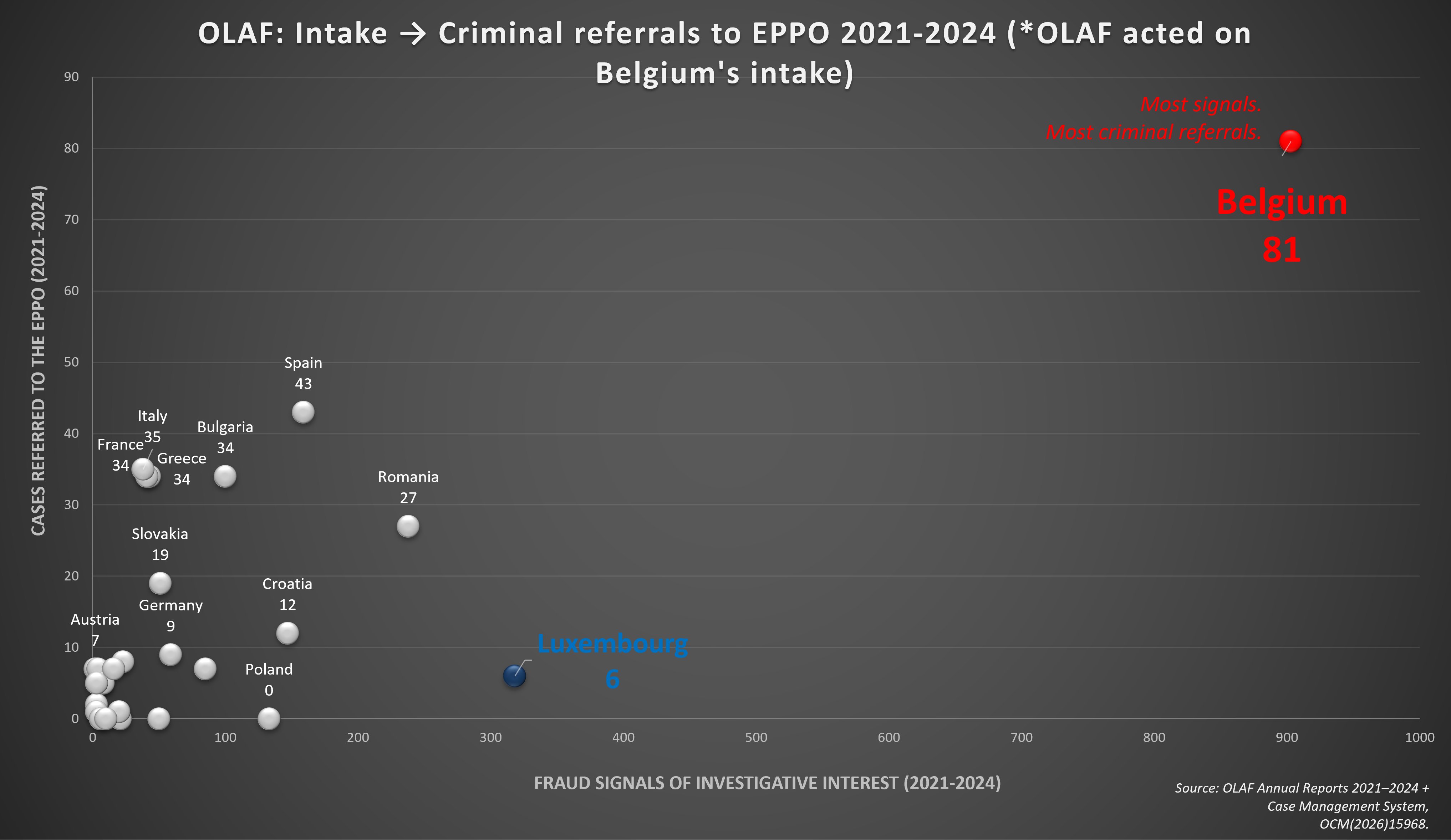
OLAF’s answer is that those signals were thin: preliminary, unverified, often about activity in other countries. The second chart tests that answer. It takes the same intake and plots what OLAF referred to the EPPO, the EU’s criminal prosecutor, over the same four years.
Here Belgium leads the EU: 81 referrals, ahead of Spain’s 43, Italy’s 35, Romania’s 27. A referral to EPPO is not a filing note. It is OLAF’s formal assessment that the information may fall within EPPO’s criminal competence. OLAF reached that judgment 81 times on Belgium-linked referrals in the same period, while publicly recording 4 concluded administrative investigations linked to Belgium. Same office, same mandate, same signals. You do not refer noise to a criminal prosecutor 81 times.
The point is not abstract: in December 2025, EPPO carried out searches at the College of Europe in Bruges and the European External Action Service in Brussels in a suspected EU-funding fraud probe, with OLAF support.
That is the oversight reality behind the defence.
The Commission checked a slice. The Court audited samples.
OLAF explained why its numbers cannot be read as a fraud proxy.
None of the three provides a public, entity-level answer to the question raised by this investigation: who received the money, who performed the work, under what structure, and what was actually checked?
“We are audited” is not false. It is incomplete. And in public money, incompleteness is the point.
I am not writing this as a political party, a lobbyist, an institution or a rival organisation. I am Anca Păduraru and I am writing it as a journalist, an EU citizen, and someone who spent years inside the Brussels association world before building, line by line, the evidence neither side brought to the table.
The right turned NGO funding into a weapon. The left answered by calling scrutiny a witch hunt.
I counted the money. I matched the names. I checked the legal entities, employer records, accounts, audit answers, OLAF data and right-of-reply responses. I published the method and the correspondence.
The result documents that the public record is too weak for anyone to honestly claim that serious NGO funding scrutiny is illegitimate.
The standard is simple: public visibility must follow public money, public influence and operational complexity. For NGOs. For companies. For universities. For consultancies. For public bodies. For everyone.
If the European Union wants trust, it cannot ask citizens to stay quiet because scrutiny is politically inconvenient.
The money has no party. Neither should the evidence.